


Image

(If you want to support Frank Mariani you can do so at https://frankmarianidesign.substack.com/ Here’s his latest work. He makes us think.)
Why do reasonable people look at the same evidence and come to completely different conclusions? This is a question at the heart of epistemology, the branch of philosophy that studies knowledge, belief, and how we justify what we think is true. Philosopher Thomas Kuhn offers a powerful way to understand it. Kuhn (1922–1996) was a historian and philosopher of science who studied how knowledge works. He argued that we don’t interpret the world in a purely objective way. Instead, we operate inside paradigms—frameworks of assumptions, priorities, and rules that shape what we notice and what counts as evidence. When two people live in different paradigms, even identical facts can appear contradictory.
This is exactly what happens when people interpret the same event differently. Belief shapes perception. In philosophy, this idea is sometimes described as “believing is seeing.” What you already accept as true changes what you notice and how you interpret it. In a related but not identical way, philosophers have said that “faith enables reason.” That doesn’t mean blind belief; it means that having prior assumptions, commitments, or frameworks often guides the way we make sense of the world. In everyday life, it might not be about religion—it could be about politics, sports, or any worldview—but the principle is the same: what we start with influences what we see.

Sunny, with a high of 89 and low of 59 degrees. Sunny for the morning, clear overnight.


One of these days, the dog and I are going to meet up with you and I'll pick your brain on cell service, curing meats in the attic, and the tour guide life!
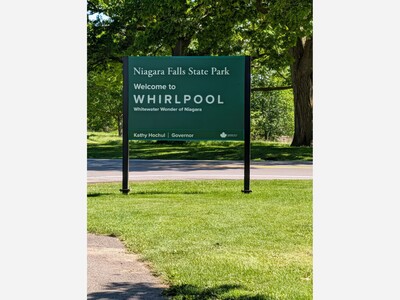
We're on Whirlpool and have had repeated issues of our cell phones picking up the Canadian cell towers across the gorge and having to argue that we're not roaming to Google fi.
I think the expanded Niagara falls State Park is a good idea because it helps showcase the extensive gorge park and trails from devils hole to the falls. Canadian side does not have anything like that. We are located near Whirlpool and I hope they continue to allow the Meadows to grow wild rather than trying to cr