Image
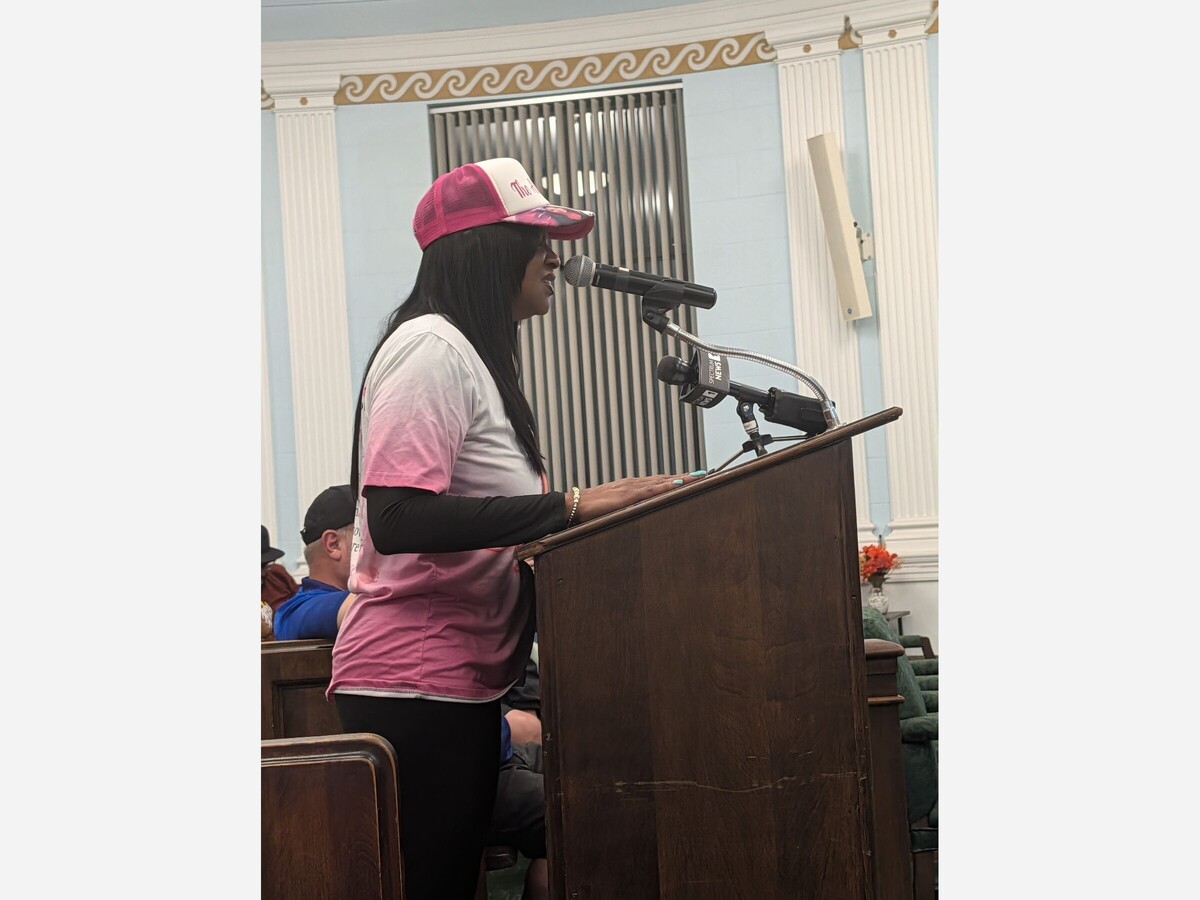
Carretha Brown addresses the Niagara Falls City Council. Her daughter Jayla was murdered on July 4 and police can't spolve the crime because witnesses won't come forward.


The Niagara Falls City Council took its traditional August sabbatical after Chairperson Brian Archie missed all of July because of the loss of his daughter.
The bottom line above the chaos is GIVE will go on.
When last they met, council members Vincent Cauley and Bridgette Myles were perseverating over a Gun Involved Violent Enforcement grant from New York State valued at $1.77 million.
The GIVE grant was postponed and then failed to pass at a special meeting. On Wednesday, the council heard from former Police Chief John Faso who supervises the GIVE program attempt to answer questions from Cauley.
Faso had already presented statistics on the GIVE to the council earlier this year. He also met outside council meetings with Cauley and Myles to discuss the program.
Myles earlier in the year tried to use GIVE funds to fund Night Gym. She was rebuffed because allocation of the funding is governed by the grant application. She has opposed the program ever since, joining Cauley in seeking accountability.
Faso, on Wednesday, carried with him a summary report on GIVE activities that was 36 pages long. The data contained is confidential because it reflects enforcement activities and investigations.
As Cauley asked about questions about GIVE, Faso explained the activities are reported to the state department of criminal justice which oversees the program in a report he is required to produce every 3 months. It takes him 3 days to produce it.
In the work session before the meeting, while Myles expressed concern about community engagement, Faso countered GIVE is a law enforcement grant. Community engagement is secondary. In the primary role, GIVE took 219 firearms off the street in the last year.
“What is out there right now is insane,” Faso said of the weapons on the street, “30-round magazines, Glock switches. This is not your Saturday special. But yes, community engagement is important.”
$54,000 in funding is dedicated to things like summer camps and movie nights. Given the underlying level of accountability, Faso said he can’t simply reallocate resources on a whim even for a well-intentioned request.
Myles requested a committee be formed to further understand and shape GIVE in the future. Faso said that would be welcome, just as he works with SNUG on its anti-gun violence activities.
Cauley’s questions were data driven. He wanted specific, drilled down answers Faso could not provide because the information is sensitive.
Cauley wanted to know “What is the number of Directed Patrols per day, per shift, per location (hot spot) since 2023?”
Faso explained “We do not track locations on the trackers submitted to the state due to the information being Law Enforcement Sensitive.”
He did however say that for 2023-2024, the number of hours spent towards directed patrols are: 397 hotspot shifts included 5,858.5 hours of police work.
For 2024-2025: 193 shifts included 2,862.5 hours.
For 2025-26: 384 shifts, 2,862.5 hours.
The number of Hot-Spot shifts conducted represents the number of times GIVE officers were deployed for Hot-Spot enforcement, it does not represent the actual number of Hot-Spots visited per shift. That number has been averaging over 2,000 per year. For example from July 1 2025-July 1 Hot-Spots were visited 2,126 times.
Faso said “hotspot” is a fluid term because criminal activity doesn’t stay in one place. Last week's hotspot might be different than one two weeks from now.
GIVE also funds two Niagara County assistant district attorneys and a paralegal at a cost of $336,000 as well as $243,000 for city-based Sheriff patrols and $42,000 for Niagara County probation. Those programs would die if Cauley was able to paralyze the program with overanalysis or the state decided not to issue a new grant because the program was reshaped to conform with Myles’s good intentions.
Pressed on the two unsolved murders from July 4 weekend, Faso said the problem is not one of police but of community. No one is coming forward with information.
Victor Johnon spoke for the good of the community and ranted about the unsolved murders, concluding by playing a video on his phone from the night of the shootings. The audio included gunshots and might be useful if he turned it over to police.
In the regular portion of the meeting, Cauley attempted to walk-on a resolution to retain outside counsel to represent the council in investigating the state of emergency put in place by Mayor Robert Restaino when Archie took time off to grieve and Cauley and Myles refused to approve paving and lawnmowing because they didn’t have enough information.
The council could not even approve minutes from its last meeting because Cauley wished for an edit and and acting Corporation Counsel Tom Deboy said the edit would need to be validated by checking the tape of the meeting.
Myles, in attempting to postpone the GIVE grant, looked out at Jayla Brown’s family in the audience and said “we need to go back to the drawing board. We need to help these families.”
The meeting devolved into chaos with Archie allowing heckling from the audience, engaging in dialogue with the gallery and ultimately calling a recess which lasted 26 minutes. When the council came back, GIVE passed 3-2.
Finally, in the for the good of the community part of the meeting, Carretha Brown implored the council to do something about her daughter’s unsolved murder.
Editor’s note: I would like those murders solved too, but when someone like Victor plays a video for the council that the police have not seen, it is emblematic of why crimes don’t get solved.
Dan McKiernan implored the council to demand the state declare his 99th Street home a Superfund site so his sick children can be relocated.
Finally, Jill Shaw, a community activist, called out Myles, who she pointed out supported GIVE until she realized she couldn’t reallocate funding for night gym, which is when she started speaking against it. Myles, from the dais, addressed Shaw directly as decorum broke again before the meeting mercifully ranted to an end.

The night gym sounds like a great program, but even people who don't write grants understand they are written pretty specifically and it's not just "give us a pile of money and we'll decide later what to do with it". I bet Myles could probably write and recieve a grant herself for the night gym if she looked into it.

Sunny, with a high of 63 and low of 49 degrees. Partly Cloudy in the morning, sunny for the afternoon, clear in the evening,